More capital, fewer rounds
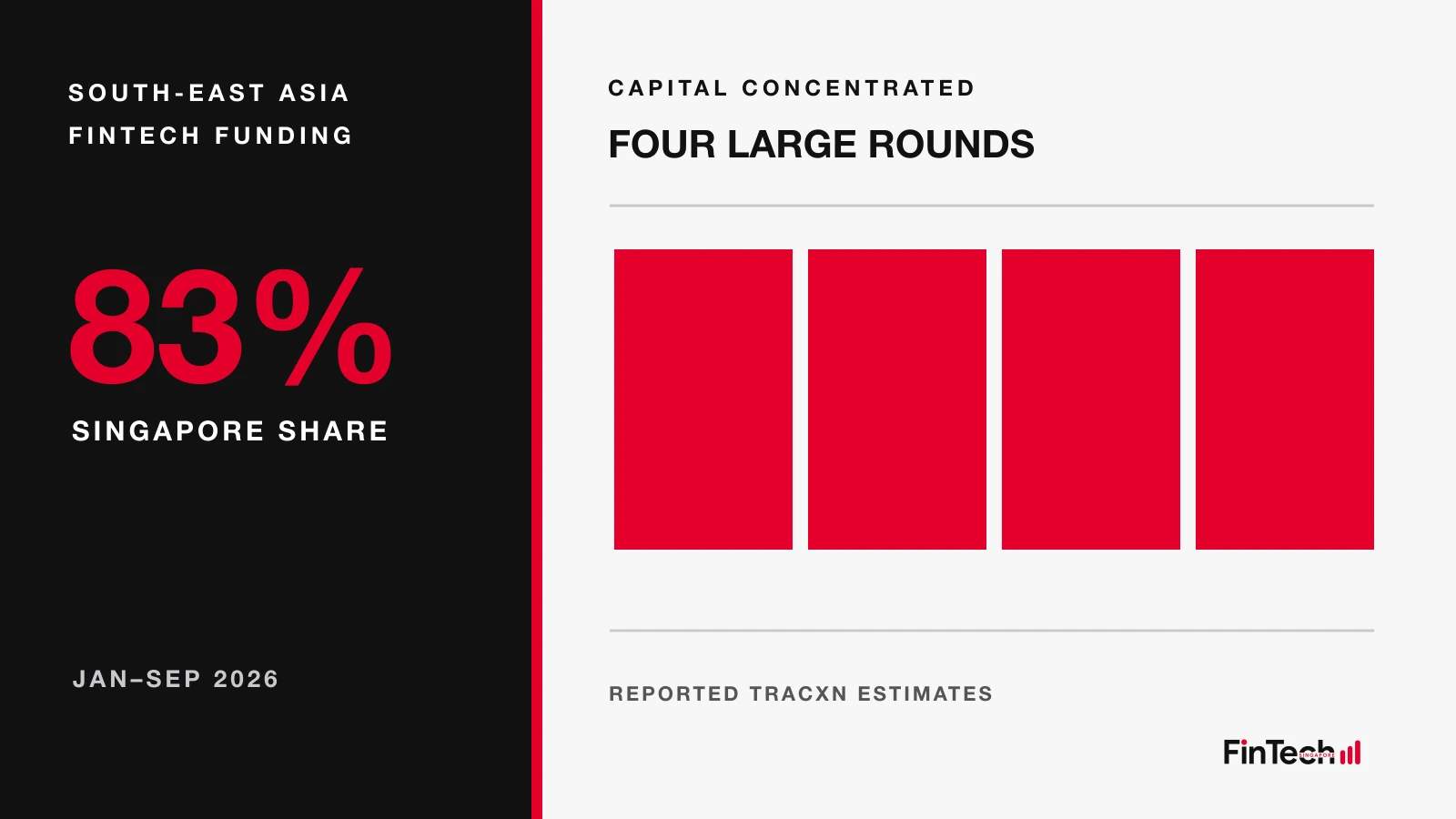
The Business Times reported on 15 October that South-east Asian fintechs raised US$2.3 billion in the first nine months of 2026, citing market-data firm Tracxn. It put Singapore-based companies at US$1.9 billion, or 83% of that regional total. Those are estimates from the cited dataset, not a measure of lending to customers or revenue earned by fintech firms.
The same account lists 42 regional funding rounds, down from 75 a year earlier. Four rounds of at least US$100 million supplied US$2 billion, or 86% of the reported total. Seed-stage funding fell to US$53.3 million, the newspaper said. The combination matters more than the headline increase: a few companies attracted much larger cheques while fewer businesses completed rounds. It does not show that financing became easier for the typical startup.
Two Singapore-linked rounds carry much of the total
Ant International, headquartered in Singapore, announced the closing of an approximately US$1.2 billion Series A in July. Crypto.com announced a US$400 million strategic investment from Citadel Securities in the same month. Together, those disclosed amounts are roughly US$1.6 billion, close to 70% of the reported regional total and about 84% of Singapore's rounded figure. The proportions are illustrative calculations from rounded totals, not separate Tracxn findings.
The funding supports those companies' own expansion plans. It does not establish similar investor demand across payments, digital banking, lending and other fintech businesses. A founder raising a smaller seed round faces a different market from a mature platform seeking hundreds of millions of dollars.
Why the growth rate needs a qualification
The Business Times says the latest Tracxn report compares US$2.3 billion with US$748 million for January–September 2025. Yet Tracxn's published report for that earlier period stated US$839 million and said its funding figures excluded debt, grants, post-IPO and initial coin offerings. We could not obtain the original 2026 nine-month report to establish whether the historical figure was revised or the coverage changed. The exact year-on-year percentage therefore remains unresolved.
Fintech.com.sg has also covered KPMG's Singapore funding estimate for the first half of 2026. That article uses a different provider, six-month period and geographic scope. Its figures should not be combined with Tracxn's nine-month regional series or used to calculate this report's growth rate.
Acquisition agreements are a separate measure
The newspaper also cites large acquisitions, including Grab–Atome and Circle–Tazapay. These transactions are distinct from money raised in equity funding rounds. More importantly, Grab's own announcement says its proposed Atome purchase is expected to complete by the third quarter of 2027, subject to approvals. Circle likewise describes its Tazapay purchase as an agreement expected to close in 2027. Neither announcement establishes a completed acquisition in the first nine months of 2026.
Our earlier Grab–Atome report explains the proposed consumer-lending transaction. Its relevance to lending does not turn a broad fintech investment survey into a new Lending story or show that borrowers have gained new credit.
What the figures actually suggest
The reported capital total shows that very large Singapore-linked fintech firms could still secure substantial investment in 2026. The fall in round count and seed funding points to a narrower market beneath that headline. Until Tracxn's original nine-month dataset and its revised 2025 comparison can be checked, the defensible conclusion is concentration, not a precise measure of a sector-wide rebound.
The next useful test is whether later reports show more companies securing first rounds and whether the number of deals rises without relying on one or two exceptional financings.