How an AI pullback could reach finance
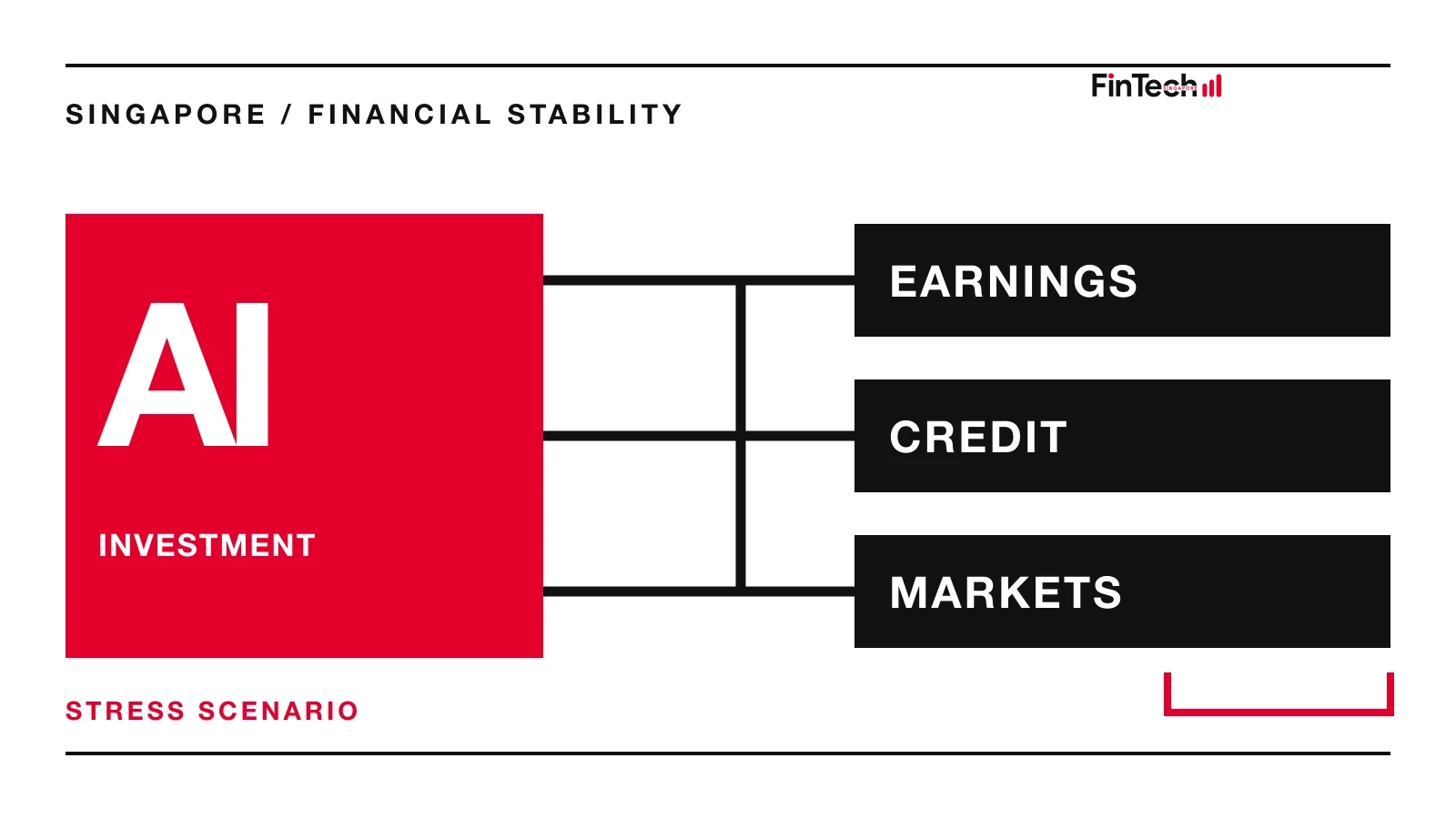
The Monetary Authority of Singapore has put an artificial intelligence investment pullback into its financial stability stress tests. Its review, released on 22 September, asks how a sharp reversal in AI spending and market expectations could affect Singapore companies, borrowers and financial institutions. The scenario is a test of resilience, not a prediction that an AI downturn has begun.
The link to finance runs through more than technology shares. Data centres and advanced semiconductors require substantial capital. If their expected returns disappoint, investors could reassess valuations and companies could cut spending. MAS warned that losses could spread across equities, corporate bonds and private credit, according to Channel NewsAsia's account of the review.
What the Singapore stress test found
MAS tested Singapore-listed companies against revenue losses along the AI supply chain and higher financing costs. The Business Times reported that the severe scenario applied revenue shocks of up to 30 per cent and interest-rate shocks of up to 400 basis points, calibrated to each company's exposure. In that scenario, about 32 per cent of listed firms were classed as at risk, representing about 16 per cent of overall corporate debt.
The regulator's at-risk measure identifies firms with interest coverage below one, or negative cash flow and less than six months of cash to cover the shortfall, according to the report cited by The Business Times. It describes how companies would fare under a deliberately severe set of assumptions. It does not mean that 32 per cent are currently failing or that the same share of banks' loans is impaired.
Most firms in the test could withstand the shock. The weaker results were concentrated among highly leveraged and capital-intensive companies, businesses dependent on working-capital financing, and smaller firms with thinner margins or cash reserves.
The fintech connection is exposure, not AI adoption
For a lender, investor or treasury platform, the useful question is where exposure to AI investment sits: with a borrower selling into the AI supply chain, with an asset whose price assumes sustained growth, or with a customer whose cash flow depends on continued capital spending. These are different risks and need different measurements.
A financing model based on a customer's recent sales could look sound while a large share of those sales comes from one investment cycle. Testing lower revenue, more expensive refinancing and delayed customer payments together would show more than changing a single growth forecast. That is an editorial implication of MAS's scenario, not a new regulatory requirement for every fintech firm.
MAS also identified higher global rates, semiconductor and electricity costs as factors raising the return required from AI projects. Those costs matter because a project can remain technologically useful yet attract less investment if its expected return no longer covers its financing and operating costs.
Buffers do not remove every weak point
MAS said Singapore's banks and insurers had sufficient capital to withstand severe macro-financial shocks, while investment funds held liquidity to meet redemptions under stress, according to Channel NewsAsia. It also assessed most firms and households as financially resilient. That system-wide finding can coexist with difficulties at individual companies or for borrowers with little spare cash.
A market repricing could tighten financing before a loan defaults. For financial institutions and fintech providers, funding availability, customer concentration and access to cash may therefore be as important to watch as headline asset prices. The review's conclusion of broad resilience should not be read as a guarantee for any one investment, business or borrower.
A separate AI risk for financial institutions
The AI investment cycle is distinct from the risk of using AI in financial services. The Business Times reported that MAS's 2026 survey of chief risk officers found cyber and operational risks had overtaken geopolitical risks as their most cited concern, reflecting worries about AI-assisted attacks and reliance on shared technology providers.
A downturn in AI spending would test balance sheets and market prices; a cyber incident or provider outage would test service continuity and controls. Both belong in a financial firm's risk assessment, but evidence about one should not be presented as proof of the other. The next useful evidence will be actual investment and earnings trends, changes in funding conditions, and MAS's subsequent assessments rather than the stress scenario alone.