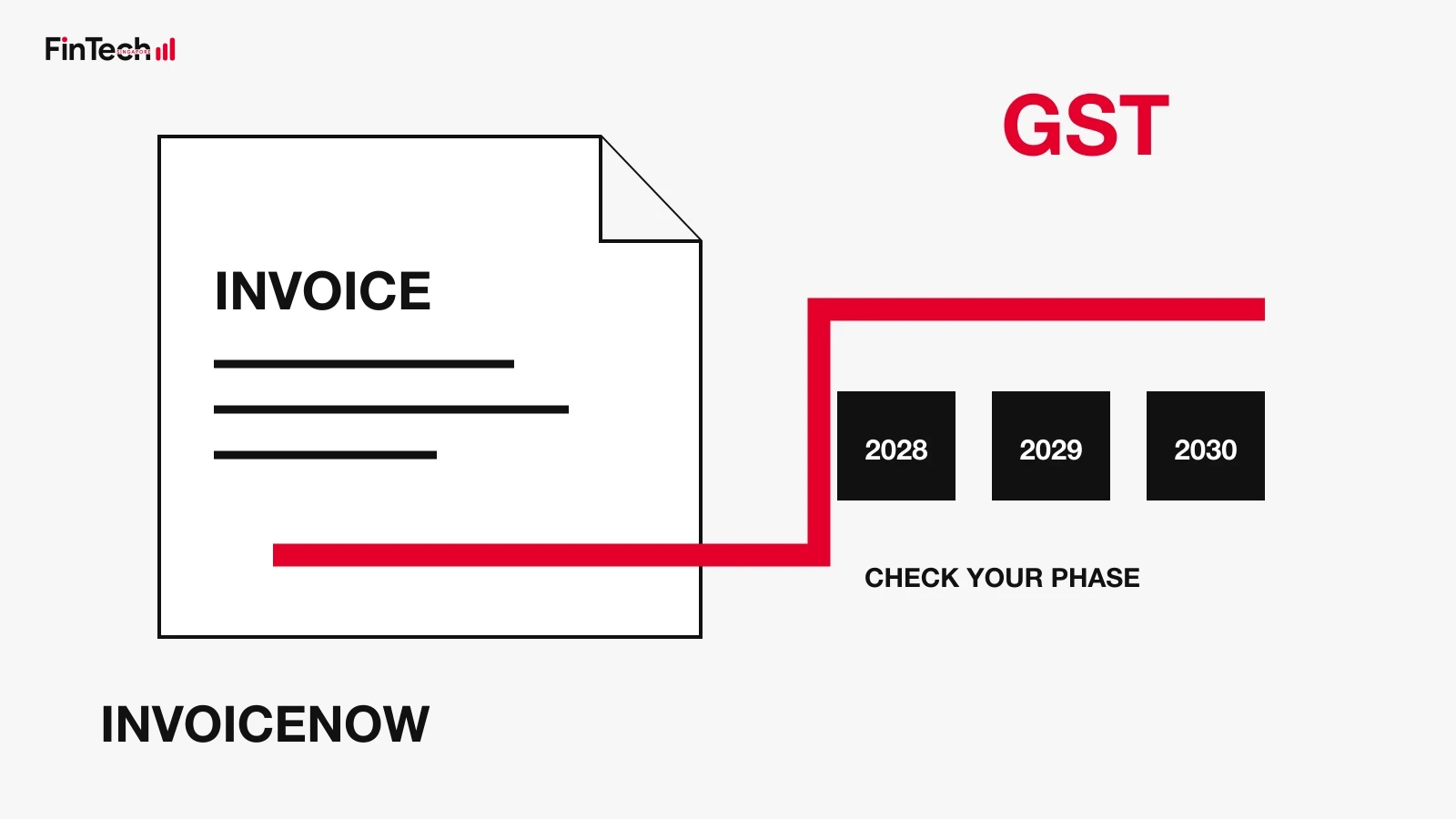
Identify your implementation phase
InvoiceNow preparation should begin with your business’s GST position, not a software sales pitch. The requirement to submit invoice data to IRAS is phased; there is no single September 2026 deadline for all Singapore businesses.
The IRAS implementation timetable covers companies registering voluntarily within six months of incorporation from 1 November 2025, and all new voluntary GST applicants from 1 April 2026.
From 1 April 2028, it covers new compulsory applicants and existing GST businesses with annual supplies up to S$200,000. The remaining existing-business phases begin on 1 April 2029 for supplies up to S$1 million, 1 April 2030 up to S$4 million, and 1 April 2031 above S$4 million.
For this phasing, annual supplies use Box 4 values for accounting periods ending in 2025. Exclusions include overseas entities and businesses registered wholly because of reverse charge. Check your circumstances against IRAS’s guidance rather than using current revenue alone.
Separate invoice data from the payment
InvoiceNow moves structured invoice information between business systems. An emailed PDF may be readable by a person, but it is not the same as sending that structured record through the network. Nor does sending an invoice establish that the customer has paid it.
This distinction helps divide the project sensibly. Your finance team owns the invoice record and tax treatment; the person managing bank reconciliation still needs a way to match subsequent receipts. A successful invoice transmission and a settled payment should remain separate statuses.
Check the software you already use
Before replacing an accounting package, ask its provider whether it supports InvoiceNow and the required submission of data to IRAS. Record what needs activation, what integration work is involved and who provides support when a transmission fails.
IMDA’s InvoiceNow provider guidance provides a starting point for accredited solutions and access-point providers. Compare the actual package you need, including user access, data export and support, rather than assuming every advertised option has identical capabilities.
For a small business, the person sending invoices may also handle purchasing and bookkeeping. Give that person a clear process for corrections and exceptions instead of leaving implementation entirely to the software vendor.
Test a complete working cycle
Use a controlled example to check customer identifiers, invoice numbers, GST treatment and the destination record. Then test a correction or credit note and confirm that the accounts team can see what succeeded and what needs attention.
Keep a short implementation record: the applicable date, the chosen solution, the person responsible for access, the test results and the escalation contact. This is a practical project checklist, not a substitute for the detailed IRAS requirements.
A business with a later deadline can use the lead time to clean its master data. Correcting duplicate customer records and inconsistent tax codes before connecting systems is generally easier than investigating them after live invoices have been sent.